Mental development
Chiiku
Karate helps build concentration, focus, clear thinking, and decisiveness.

Resources & Details
Meet the pioneering masters who founded, standardized, and expanded Japan Karate Association (JKA) Shotokan Karate globally. Select a master below to view their complete biography.
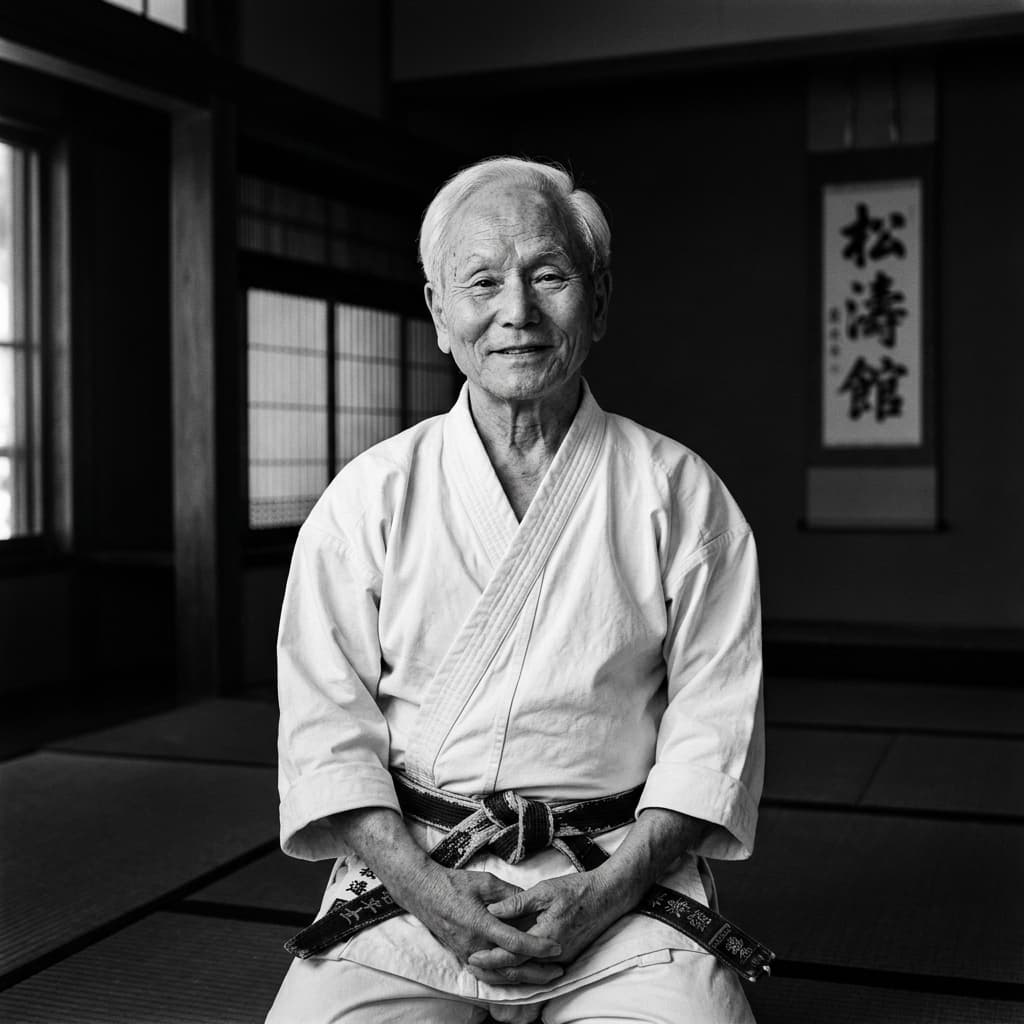
Gichin Funakoshi is widely revered as the "Father of Modern Karate" and the founder of the Shotokan style. He devoted his life to transforming a secretive Okinawan martial art into a global path of physical education, self-defense, and character development.
"The ultimate aim of karate lies not in victory or defeat, but in the perfection of the character of its participants."
Born into a samurai family in Shuri, Okinawa, Gichin Funakoshi was a weak and sickly child. To improve his health, his family enrolled him in martial arts training under the legendary Okinawan masters Ankō Asato and Ankō Itosu.
Under their strict tutelage, Funakoshi practiced Okinawan Te (the precursor to modern karate) in secret, as the practice of martial arts was banned by the Japanese government at the time. Through years of dedicated practice, he not only built a robust physical body but also developed a profound appreciation for the mental and philosophical aspects of the art.
In 1922, at the age of 54, Funakoshi was selected to travel to Tokyo to demonstrate Okinawan karate-jutsu at the First Ministry of Education Physical Education Exhibition. His demonstrations captivated the audiences, including Jigoro Kano (the founder of Judo), who invited him to present at his Kodokan Dojo.
Encouraged by mainland martial artists and universities, Funakoshi chose to remain in Japan to spread the art. He established karate clubs at prestigious universities, including Keio, Waseda, and Takushoku. In 1939, his students built the first official dedicated dojo for him in Tokyo, naming it Shotokan—derived from Funakoshi's pen name, Shoto (meaning 'pine waves'), which he used when writing poetry and calligraphy.
Following the destruction of the original Shotokan dojo during World War II, Funakoshi's senior students regrouped to establish the Japan Karate Association (JKA) in 1949. Funakoshi was appointed its first Supreme Master, providing symbolic and philosophical leadership.
Funakoshi firmly believed that karate should be practiced as a path to peace. He formulated the twenty precepts of karate (the Niju Kun), starting with the cardinal rule: 'Karate Ni Sente Nashi'—meaning 'There is no first strike in karate.' His philosophy taught that a karate practitioner must be calm, courteous, and avoid conflict whenever possible, using physical techniques only in absolute self-defense.
At the JKA, thousands of children and youth members—from elementary school to high school—learn the values of karate and apply them in their daily life.
JKA has long supported school-age karate through structured tournaments, youth divisions, and camps designed specifically for children and teenagers:
Karate is not only fun. It supports the same three pillars of personal development found in traditional education: mental, moral, and physical growth. It gives young people balance and perspective at an age when they are needed most.
Mental development
Karate helps build concentration, focus, clear thinking, and decisiveness.
Moral development
It cultivates patience, discipline, perseverance, understanding, confidence, self-control, courtesy, and calmness.
Physical development
Karate strengthens the heart, bones, and muscles while supporting resilience and resistance to sickness and injury.
Other karate organizations often allow children as young as six or seven to start kumite (sparring). At the JKA, sparring is strictly prohibited until a child is at least ten years old and in the fifth grade, helping reduce the possibility of injury while preserving the pure spirit of training.
Key historical milestones and licensing achievements of the Japan Karate Association World Federation Bangladesh.
A historic milestone was achieved when Bangladesh received its first official JKA WF Country Licence—the first recognition of its kind in the nation's history. The licence was formally presented at the JKA WF Headquarters in Tokyo, where Sensei Tulu Ush Shams, Country Representative, led the Bangladesh delegation. He was accompanied by Sensei Imtiaz Salim during the official licensing ceremony.